How to roll over a 401(k) without a tax hit
A direct rollover moves your old 401(k) to an IRA with zero tax. Mistakes can trigger income taxes and early-withdrawal penalties. Here is the right way, step by step.
When you leave a job, your old 401(k) doesn't have to stay put — and it usually shouldn't. The safe move is a direct rollover: the money goes trustee-to-trustee from your old plan into an IRA or new employer plan, nothing is withheld, and you owe no tax. Do it the wrong way and the plan withholds 20% that you must replace from your own cash, and any amount not redeposited within 60 days is taxed as income, plus a possible 10% penalty if you're under 59½. This guide covers direct vs. indirect rollovers, the 60-day trap, where to send the money, the real costs, a worked example, mistakes to avoid, and the exact steps.
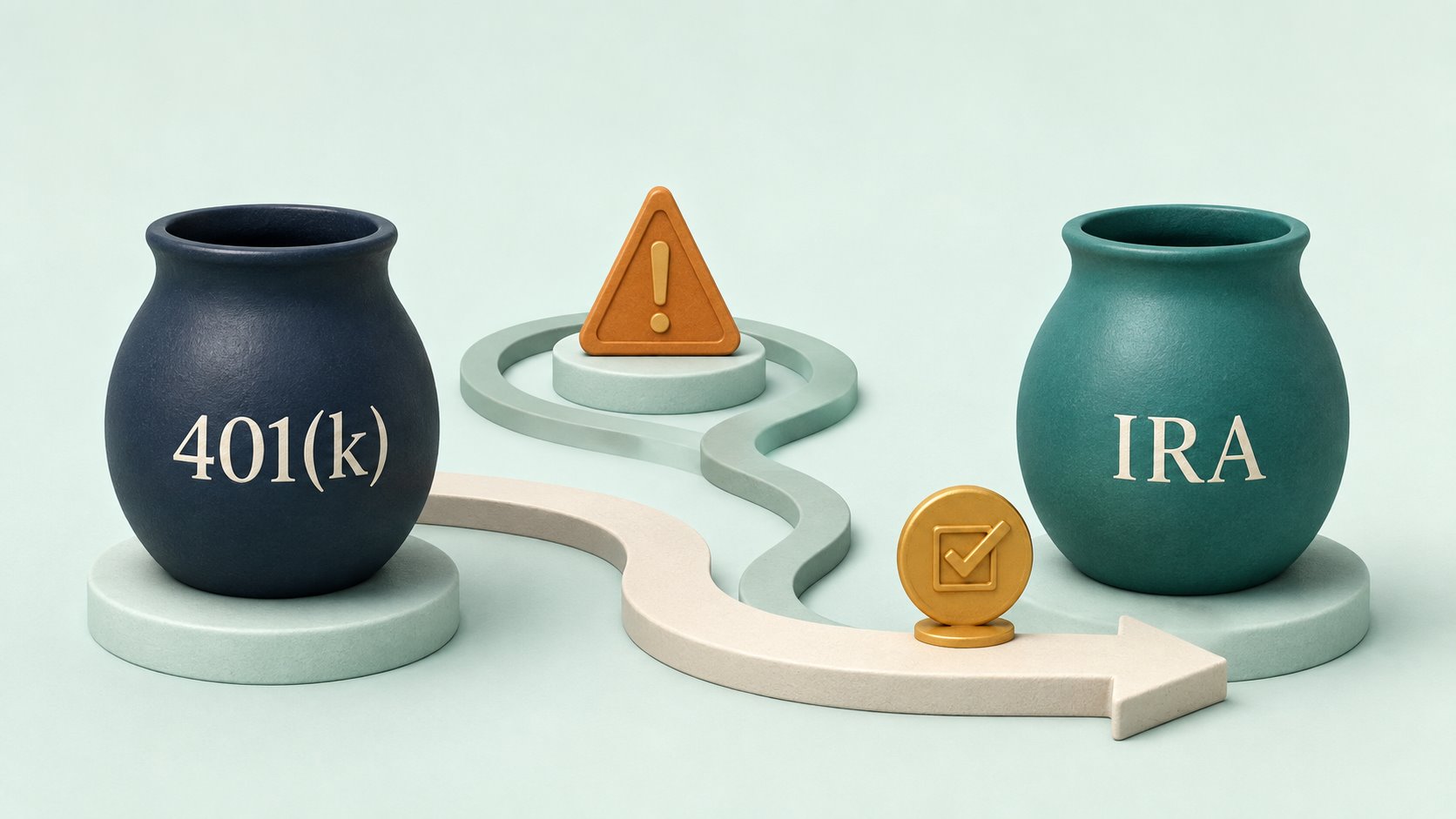
Illustrative for someone under 59½. A direct (trustee-to-trustee) rollover moves the full balance with no tax. Cashing out means 20% is withheld toward your tax bill up front (a prepayment, not an extra tax), the full amount is taxed as ordinary income, and a 10% early-withdrawal penalty applies.
How a 401(k) rollover actually works
A rollover moves retirement money from one tax-advantaged account to another without cashing it out. Because the funds stay inside the tax-deferred system, the IRS doesn't treat the move as a withdrawal — as long as you follow the rules. The mechanics differ sharply depending on who holds the check along the way.
There are two paths. In a direct rollover, your old plan sends the money straight to the receiving custodian; you never have constructive receipt of it. In an indirect rollover, the plan pays you, and you have a tight window to redeposit it yourself. The IRS explains both in its rollover guidance, and the difference drives every other decision below.
Direct vs. indirect rollover
This is the whole ballgame:
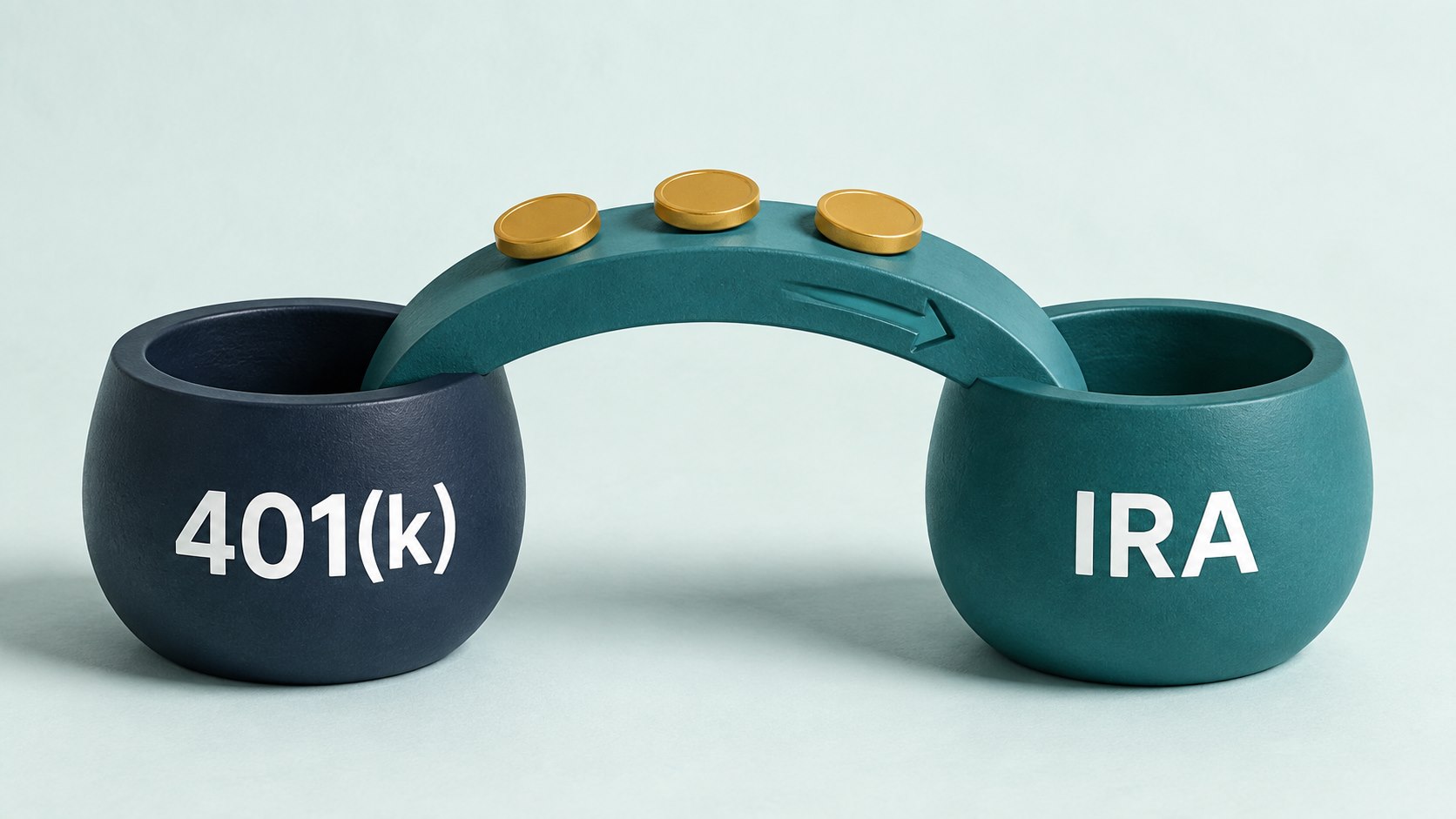
- Direct rollover (do this). The money moves trustee-to-trustee — from your old plan straight to the new IRA or plan. You never touch it, nothing is withheld, and there's no tax. Ask for a "direct rollover" and have the check made out to the new custodian, not to you.
- Indirect rollover (avoid). The plan cuts you a check. They're required to withhold 20% for taxes, and you have just 60 days to deposit the full original amount into an IRA — including the 20% they kept (which you have to front from your own cash) — or the shortfall is treated as a taxable distribution, plus a 10% penalty if you're under 59½.
The 60-day rule and the once-per-year limit
If you ever do an indirect rollover, the 60-day clock is hard — miss it and the IRS treats the money as withdrawn, with income tax and a possible 10% early-withdrawal penalty. The IRS can waive the deadline only in narrow situations such as bank error or serious illness, and you generally have to ask.
There's also a once-per-12-months limit on indirect IRA-to-IRA rollovers — and it applies across all your IRAs combined, not per account. That cap doesn't apply to 401(k)-to-IRA rollovers at all; for a plan rollover, the 60-day clock and the 20% withholding are the real risks, and avoiding both is the single biggest reason to always choose direct.
Where to roll it — your four options
- Into an IRA — the most common choice. Widest investment menu, often lower fees, full control. Traditional 401(k) → traditional IRA keeps it tax-deferred; see traditional vs. Roth IRA.
- Into your new employer's 401(k) — fine if the plan has low fees and good funds, and it preserves the ability to borrow and to delay RMDs while you keep working.
- Leave it where it is — allowed if the balance is above the plan's cash-out threshold, but you lose consolidation benefits and may pay higher fees.
- Cash out — almost never. You owe income tax plus a 10% penalty if you are under 59½ (20% is withheld up front toward that bill) and torch decades of compounding.
Who should roll to an IRA vs. who should keep the 401(k)
Roll to an IRA if you want the broadest fund selection, lower expense ratios, and one consolidated account you actually monitor. Keep or move into a 401(k) if you value its stronger federal creditor protection, plan to use the "rule of 55" (penalty-free withdrawals if you leave at age 55+), want to keep the door open for a backdoor Roth (a big pre-tax IRA balance complicates the pro-rata math), or have access to institutional funds you can't buy retail.
The real numbers: what each path costs
The damage from a cash-out is easy to underestimate. Here's how a hypothetical $100,000 balance plays out under each route for someone under 59½ in a 22% bracket. Figures are round and illustrative, not a tax quote.
| Option | Tax now | Penalty | Lands in retirement account |
|---|---|---|---|
| Direct rollover to IRA | $0 | $0 | $100,000 |
| Indirect rollover, redeposited in full on time | $0 (20% refunded later) | $0 | $100,000 |
| Indirect rollover, only the net redeposited | ~$4,400 on the $20,000 gap | ~$2,000 | $80,000 |
| Full cash-out | ~$22,000 | ~$10,000 | $0 |
Worked example: the cost of getting it wrong
Say your old 401(k) holds $100,000 and you're 45. You request a check instead of a direct rollover.
- The plan withholds 20% → it sends you $80,000 and forwards $20,000 to the IRS.
- You deposit the $80,000 into an IRA but don't replace the missing $20,000.
- That uncovered $20,000 is now a taxable distribution. At a 22% rate that's about $4,400 in income tax, plus a 10% early-withdrawal penalty of $2,000.
- Net result: roughly $6,400 lost on a move that should have cost $0 — and $20,000 less compounding for the next 20 years.
Roth 401(k) and conversions
A Roth 401(k) rolls into a Roth IRA tax-free. One catch: years in the Roth 401(k) don't count toward the Roth IRA's five-year clock. If this is your first Roth IRA, earnings you withdraw within five tax years can be taxable even after 59½; if you opened any Roth IRA at least five years ago, that earlier start counts and this isn't an issue. A traditional 401(k) rolled into a Roth IRA is a conversion — you'll owe ordinary income tax on the converted amount this year, but it grows tax-free afterward and isn't subject to lifetime required minimum distributions in a Roth IRA.
Conversions shine in a low-income year — a gap between jobs, early retirement before Social Security and RMDs begin, or a year with large deductions. Run the bracket math first: converting too much in one year can push part of the money into a higher bracket. See traditional vs. Roth IRA for how the two account types compare.
Pros and cons of rolling to an IRA
| Pros | Cons |
|---|---|
| Far wider investment menu | No rule-of-55 early access |
| Often lower expense ratios and fees | Weaker creditor protection than a 401(k) in some states |
| One consolidated account to manage | Pre-tax IRA balance can block a clean backdoor Roth |
| Easier Roth conversions and beneficiary control | You must reinvest the cash yourself after it lands |
Mistakes to avoid
- Taking the check in your own name. That triggers 20% withholding and starts the 60-day clock. Always confirm the payee is the new custodian.
- Forgetting to replace the withheld 20%. If you must do an indirect rollover, front the missing amount or part of your money gets taxed and penalized.
- Leaving the money in cash. Rollover funds usually arrive as uninvested cash and sit there earning little until you place trades. Reinvest promptly.
- Mixing after-tax and pre-tax dollars carelessly. If your 401(k) holds after-tax contributions, ask the plan to split the rollover so pre-tax goes to a traditional IRA and after-tax to a Roth IRA.
- Ignoring a 401(k) loan. An unpaid loan balance can become a taxable offset when you leave; plan for it before you separate.
- Rolling over company stock on autopilot. If your 401(k) holds employer stock with large gains, rolling it into an IRA forfeits net unrealized appreciation (NUA) treatment, which can let you pay capital-gains rates on that growth instead of ordinary income. Get tax advice before you move it.
Step by step
- Open the receiving IRA (or confirm the new 401(k) accepts rollovers).
- Call your old plan and request a direct rollover; give them the new custodian's payee details. If you've reached RMD age (73, or 75 if born 1960 or later), take that year's required minimum distribution first — RMDs can't be rolled over, and rolling one in creates an excess IRA contribution taxed 6% a year until you fix it.
- If they mail a check, make sure it's payable to the custodian "FBO [your name]," not to you.
- Confirm the funds landed and reinvest them — money often arrives as cash and sits uninvested until you act.
- Keep the paperwork; a direct rollover is reported on Form 1099-R but not taxed.
Related: traditional vs. Roth IRA and 401(k) rollover mistakes to avoid.